
Every physical retailer has the same core goal: sell more, serve customers better, and build a business that grows sustainably. In 2026, the most effective tool for achieving all three simultaneously is an AI sales assistant.
This is no longer a bold claim. It is backed by verified data from across the retail industry. According to Shopify Enterprise’s 2026 AI in Retail Report, 87% of retailers who implemented AI saw a positive impact on their revenue, and 94% reported reduced operating costs. These results are being achieved in physical stores, not just online.
Below are ten proven, realworld ways that AI sales assistants specifically Ask Ai are helping physical retailers increase revenue right now.
📊 87% of retailers report AI had a positive impact on revenue. 94% say it reduced operating costs. 97% plan to increase AI spending in 2026 Shopify Enterprise, AI in Retail 2026
1. Guiding Every Customer to the Right Product Faster
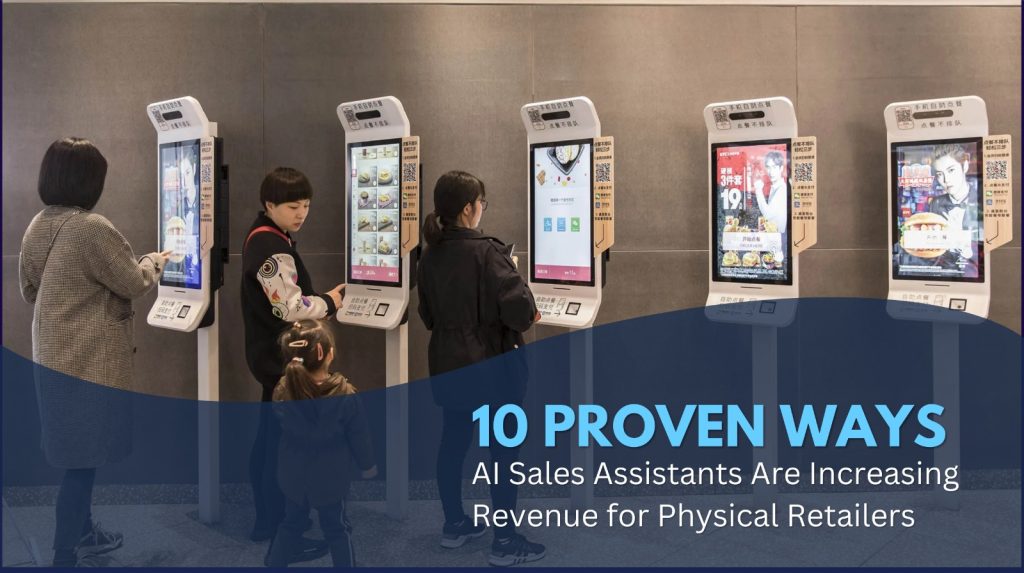
When a customer cannot find what they need quickly, they leave. It is that simple. An AI sales assistant acts as an alwayson product expert, instantly guiding customers to the right product or department based on their query whether they type it, speak it, or browse through a kiosk.
Faster product discovery means fewer frustrated customers leaving without a purchase. In a busy store with limited staff available, this single capability can meaningfully lift conversion rates across every trading hour.
2. Increasing Average Order Value Through Intelligent Basket Building
AskAi is connected to a retailer’s live product catalogue and trained to identify complementary products items that are frequently purchased together or that naturally accompany the product a customer is already considering. This is the instore equivalent of Amazon’s ‘customers also bought’ feature.
Barilliance research shows that sessions where customers engage with AI product recommendations show a 369% increase in average order value. Even a modest version of this effect where a customer buys one additional relevant product per visit has a significant cumulative impact on monthly revenue.
📊 Sessions with AI product recommendation engagement show up to 369% higher average order value Barilliance Research
3. Converting Browsers Into Buyers With Instant Information
A customer who is browsing but unsure is a customer who needs information. Questions about specifications, compatibility, stock availability, warranty, and returns policy if these go unanswered, the customer leaves without buying. If they are answered instantly, the customer buys with confidence.
AI chatbots and assistants increase ecommerce conversion rates by up to 30%, according to customer service data from Fullview. While this figure applies to digital channels, the same principle holds in physical stores: customers who get the answers they need convert at significantly higher rates than those who do not.
4. Maximising Revenue During Peak Trading Hours
Peak hours weekend afternoons, preChristmas shopping, Bank Holiday weekends are your highestopportunity periods. They are also the periods when your staff are most stretched and most likely to miss upselling opportunities.
askAi handles unlimited simultaneous customer interactions, meaning that every customer in your store during a peak period receives immediate attention. No waiting. No missed conversations. No lost sales because there simply was not enough staff to go around.
💡 A retailer converting just 5% more of their peakhour walkins to purchases enabled by AI handling the information demand can see a significant uplift in weekly revenue without hiring a single additional staff member.
5. Personalising Promotions to Drive Repeat Purchases
Generic promotions are losing effectiveness as customers increasingly expect relevance. AI assistants connected to loyalty programmes can surface personalised offers at the right moment when a customer is already instore and engaged, making them significantly more receptive to promotional messaging.
According to Gladly’s 2026 Retail AI Report, personalised shopping experiences using generative AI increase conversion rates by up to 15%. For physical retailers, this means that connecting askAi to your existing loyalty programme is one of the fastest ways to increase the return from your promotional spend.
📊 AIpowered personalised shopping increases conversion rates by up to 15% Gladly AI in Retail Industry Report 2026
6. Reducing Lost Sales From Unanswered Language Barriers
In Ireland’s major cities, a meaningful proportion of daily retail foot traffic comes from customers whose first language is not English. When those customers cannot communicate effectively with your store, they are significantly less likely to buy.
askAi communicates naturally in multiple languages. This is not just an inclusivity feature it is a revenue feature. Every customer who can engage confidently with your store, regardless of their language, is a potential sale that would otherwise have been lost.
7. Empowering Staff to Focus on HighValue Sales
Every minute a member of your sales team spends answering the same product question for the tenth time that day is a minute they are not spending on a highvalue consultation, a relationshipbuilding conversation with a loyal customer, or a complex sale that genuinely requires human expertise.
When askAi takes the weight of routine queries off your team, those team members become more commercially productive. Stores that pair strong human staff with AI support consistently outperform stores relying on either alone.
8. Building Loyalty That Drives Return Visits
The cost of acquiring a new customer is significantly higher than the cost of retaining an existing one. AI assistants that deliver consistently excellent, personalised instore experiences create the kind of loyalty that brings customers back.
When a customer knows that visiting your store means receiving instant, accurate, and tailored assistance every single time, regardless of how busy the store is they do not shop around. They return. And returning customers are the backbone of sustainable retail revenue.
9. Generating Actionable Data From Every Customer Interaction
Every conversation askAi has with a customer is a source of commercially valuable data. Which products generate the most questions? Which categories have the highest rate of unanswered queries? Where do customers tend to drop off in their purchase journey?
This data allows retailers to make smarter decisions about product selection, store layout, promotional strategy, and staff training all of which have a direct and measurable impact on revenue.
📊 According to Gartner, retailers using realtime data analytics improve their inventory decisions by up to 35% Gartner Retail Technology Trends 2026
10. Extending the Customer Relationship Beyond the Store
With askAi, the instore experience does not end when a customer walks out the door. QR codes allow customers to continue their interaction with the AI assistant at home getting postpurchase support, discovering complementary products, or reengaging with a decision they left unfinished instore.
This continuity of experience keeps your brand central to the customer’s purchase journey and increases the likelihood of a followup visit, an online purchase, or a recommendation to friends and family.
The Revenue Opportunity in Numbers
Bringing these ten capabilities together, the commercial case for AI in physical retail is clear. According to BCG research cited in 2026 retail AI data, personalisation leaders retailers who use AI to deliver relevant, personalised experiences are growing approximately 10 percentage points faster annually than competitors who do not.
For an Irish retailer generating €1 million in annual revenue, a 10% improvement in revenue growth is €100,000. For a larger retailer, the figures are proportionally larger. AI is not a cost it is a commercially proven investment.
Conclusion
The evidence is unambiguous. AI sales assistants are increasing revenue for physical retailers across every dimension: higher conversion rates, higher average order values, better customer retention, and more effective use of staff time. For Irish bricksandmortar businesses ready to compete and grow in 2026, askAi is the platform that delivers all of this in a single, purposebuilt solution.
🚀 Ready to Transform Your Store? Visit askai.ie to discover how askAi helps Irish bricksandmortar retailers increase sales, serve more customers, and compete confidently in 2026.
FREQUENTLY ASKED QUESTIONS
Q: How quickly can an Irish retailer see revenue results from implementing askAi?
A: Most retailers see initial improvements within 30 to 60 days of implementation, with measurable revenue and conversion impacts typically becoming clear within 60 to 90 days. The speed of impact depends on footfall, the complexity of your product range, and how actively customers engage with the AI assistant.
Q: Does askAi work for both small independent Irish stores and large retail chains?
A: Yes. askAi is designed to scale to businesses of any size. A singlelocation independent retailer benefits from the same core capabilities instant product guidance, multilingual support, basket building as a large multilocation chain. The platform adapts to the size and complexity of your business.
Q: What types of Irish retail businesses benefit most from AI sales assistants?
A: Any physical retail business that serves walkin customers can benefit. The impact is particularly strong in categories where customers have product questions before purchasing electronics, health and beauty, fashion, home furnishings, pharmacy, sports equipment, and specialist independent retailers. Businesses with diverse customer demographics also see significant benefits from multilingual AI support.
Q: How does AI basket building work in a physical store?
A: askAi is connected to your live product catalogue and trained to identify products that are logically or frequently purchased together. When a customer is viewing or enquiring about a specific product, the AI proactively suggests relevant complementary items similar to how major online retailers recommend related products, but delivered through an instore kiosk or QR code experience.
Q: Can askAi integrate with existing loyalty programmes and pointofsale systems?
A: Yes. askAi is designed to integrate with existing retail technology infrastructure, including loyalty programmes and product management systems. This integration is what enables personalised recommendations, realtime stock accuracy, and datadriven insights. Your team at askai.ie can walk you through the integration process for your specific setup.