
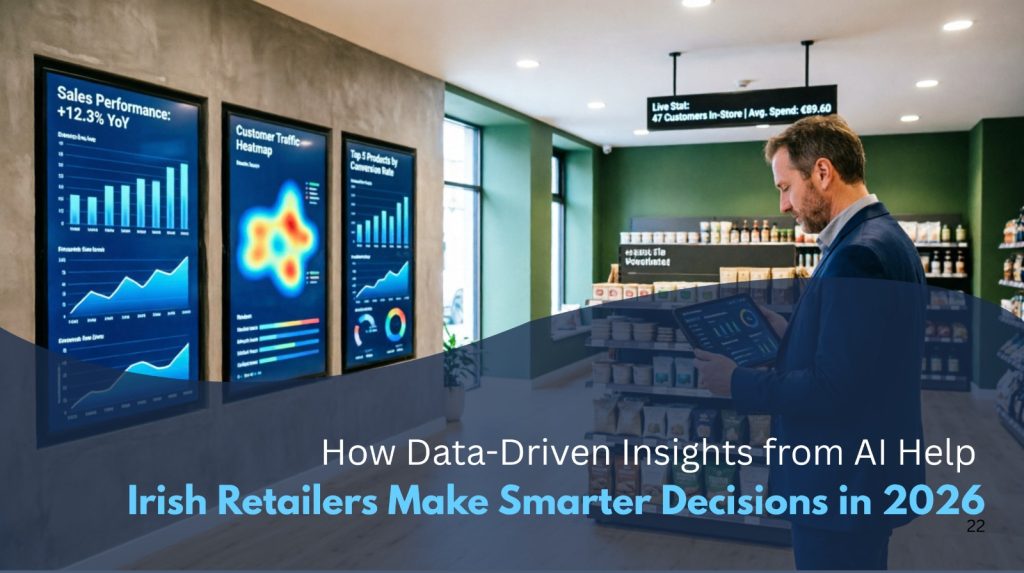
The Intelligence Gap That Has Always Disadvantaged Physical Retail
Online retailers have had access to granular customer data for decades. Every page visit, every search query, every abandoned cart, every product comparison, all of it is captured, analysed, and used to make smarter decisions about product selection, pricing, promotions, and customer experience. The scale of this intelligence has always given digital retailers a structural advantage over their physical counterparts, who have traditionally operated with sales data, rough footfall counts, and the accumulated intuition of experienced staff.
In 2026, this gap is closing. Every conversation an AI assistant has with a customer in a physical store generates precise, commercially valuable data about what customers need, what questions they have, what products they want, and where they encounter friction. For Irish retailers, this data intelligence is one of the most powerful and most underutilised benefits of deploying AI. This blog explores the specific types of insight Ask-Ai generates, how Irish retailers can use this intelligence to make smarter decisions, and why data-driven retail is no longer the exclusive domain of large chains with dedicated analytics teams.
📊 Retailers using AI-powered real-time data analytics improve inventory and staffing decisions by up to 35 per cent. Gartner Retail Technology Trends, 2026.
Five Categories of Insight That Ask-Ai Generates
1. Customer Query Intelligence
Ask-Ai records every question customers ask across all access points throughout the trading day. This creates a precise, real-time picture of what your customers want to know. Which products generate the most questions? Which questions are asked most frequently? Which questions does the AI struggle to answer fully because the relevant information is not in the product catalogue?
This query data is commercially invaluable. If 40 per cent of customers who interact with the AI are asking about a product that is currently out of stock, that is not just a missed sale. It is a clear and urgent signal to prioritise restocking. If customers are repeatedly asking a question that the AI cannot fully answer, that is a signal to improve your product information, your signage, or your staff training.
2. Interaction Volume by Time and Day
Ask-Ai tracks the volume of customer interactions at every hour of every trading day. For Irish retailers, this creates a precise map of when customers are most actively seeking information and therefore most likely to be in a buying mindset. This data informs staffing decisions, promotional timing, and operational planning in ways that rough footfall estimates simply cannot support. Knowing that your customers are most information-seeking between 2pm and 5pm on Saturdays, for example, allows you to ensure your most experienced staff are on the floor during exactly those hours.
3. Product Interest and Conversion Signals
Ask-Ai tracks which products customers enquire about, which they explore in depth, and which they move on from without engaging further. Products with high enquiry rates but low purchase rates may indicate a pricing issue, a product information gap, or a stock accuracy problem worth investigating. Products that consistently convert well from AI interactions are candidates for increased promotional support and prominent positioning in the store layout.
4. Multilingual Customer Demographics
Ask-Ai records the languages in which customers engage with the system. For Irish retailers serving diverse communities, this provides concrete data about the linguistic composition of their actual customer base, not estimated demographics, but real usage patterns. This informs decisions about multilingual signage, staff recruitment priorities, and the community marketing strategies that will have the highest return on investment.
5. Basket Building Acceptance Rates
Every complementary product recommendation the AI makes generates a data point: was it accepted, explored, or passed over? Over time, this creates a detailed picture of which product pairings resonate with customers in your specific store and which do not. The AI learns from this data to refine its recommendations. The retailer benefits from seeing which complementary relationships are commercially strongest in their particular context.
How Irish Retailers Are Using This Intelligence
Smarter Stock Decisions
When AI interaction data shows that a product is generating consistent customer interest but is frequently unavailable, the case for stocking it more deeply is grounded in evidence rather than intuition. Retailers using AI query data to inform their buying decisions are reducing both the costly problem of overstocking products customers do not want and the equally costly problem of running out of the ones they do.
📊 AI-informed demand forecasting achieves SKU-level accuracy of 82 to 88 per cent, compared to 65 to 75 per cent for traditional statistical methods. Mordor Intelligence AI in Retail Market Report, 2026.
Better Promotional Planning
Understanding which products generate the highest AI interaction interest, and which promotions drive the highest customer engagement through digital displays and QR codes, allows retailers to make promotional decisions based on evidence. Products already generating significant customer interest are natural candidates for promotional support. Products generating little engagement despite prominent positioning may need repositioning, repricing, or replacement.
Continuous Product Information Improvement
Ask-Ai records the questions customers ask that the AI cannot fully answer, a direct signal about gaps in product information, catalogue completeness, or store layout clarity. If customers are repeatedly asking about product compatibility or warranty details that are not currently in the system, addressing those gaps improves both the AI’s performance and the broader quality of information available across all customer-facing channels.
Why This Matters for Independent Irish Retailers
One of the most significant misconceptions about data-driven retail is that it requires a sophisticated analytics team, expensive software platforms, and months of data engineering to become useful. In practice, ask-Ai surfaces actionable insights in a format that any retail manager can understand and act on, without requiring technical expertise or dedicated data science resources. For an independent retailer in Limerick or a family business in Waterford that has never had access to this kind of customer intelligence before, the impact can be genuinely transformational.
💡 96 per cent of retail executives expected revenue growth in 2026. The ones achieving it are the ones using data intelligently, not just those spending the most on inventory or marketing. Deloitte Retail Executive Survey cited by DontPayFull, 2026.
Conclusion
The data intelligence that ask-Ai generates is not a secondary benefit of deploying AI in your store. It is one of the primary commercial assets, a continuous stream of customer insight that gets richer and more actionable with every passing week as the AI accumulates interactions and the patterns within them become increasingly clear. For Irish physical retailers who want to close the intelligence gap that has historically advantaged online retail, ask-Ai is the most practical and immediately available solution.
Take the Next Step for Your Store. Visit askai.ie today to see how ask-Ai helps Irish physical retailers serve every customer brilliantly, sell more confidently, and grow sustainably in 2026.
FREQUENTLY ASKED QUESTIONS
Q: How does a retailer access the insights generated by ask-Ai?
A: Ask-Ai provides an analytics dashboard that presents key interaction data in a clear, actionable format. This includes query frequency, interaction volume by time period, product interest trends, language usage, and basket building acceptance rates. The dashboard is designed for retail managers rather than data analysts. No technical expertise is required to understand and act on the information it provides.
Q: Is customer interaction data from ask-Ai stored securely and in compliance with GDPR?
A: Yes. Ask-Ai is designed with GDPR compliance as a foundational requirement. Customer interaction data is processed and stored in accordance with EU data protection regulations. Customer interactions do not require customers to provide personal data, and the insights generated are based on anonymised interaction patterns rather than identifiable individual data.
Q: How quickly does ask-Ai generate meaningful insights?
A: Most retailers begin to see meaningful patterns in their AI interaction data within the first two to four weeks of deployment, particularly in high-footfall environments. Initial insights about peak interaction periods and most-asked product questions often become visible within the first week. The richness and specificity of insights grows as the dataset accumulates over months.
Q: Can AI interaction data be integrated with existing POS and retail management systems?
A: Ask-Ai is designed to work alongside existing retail management infrastructure. The AI’s interaction data complements the sales and inventory data captured through your existing POS system, creating a more complete picture of customer behaviour than either source provides alone. Integration options depend on your current system and are assessed during the implementation process.
Q: What is the most commercially valuable insight that ask-Ai generates for Irish retailers?
A: Based on retailer feedback, the most immediately actionable insights are product query data, revealing what customers want that may not be adequately stocked or communicated, and interaction volume by time period, enabling more precise staffing and promotional timing. Over the medium term, basket building acceptance rate data and language usage patterns become increasingly valuable for product range and community marketing decisions.