
Why Your Loyalty Programme Is Underperforming
Customer loyalty programmes have been a feature of Irish retail for decades. From stamp cards to digital points systems, the commercial logic has always been sound: reward customers for returning, and make the reward compelling enough that they keep choosing you over the competition. The challenge in 2026 is that the majority of loyalty programmes are failing to deliver on this logic at the scale they should.
The US loyalty programme market alone reached 27.26 billion dollars in 2025, according to DontPayFull research. Yet consumer satisfaction with loyalty programmes sits at just 48 per cent. The average consumer belongs to 17 loyalty programmes but actively uses fewer than half. Generic points systems that offer the same ten per cent discount to every member are increasingly invisible to consumers who have been conditioned by Netflix, Spotify, and Amazon to expect experiences that feel genuinely individual.
The solution is AI. Ask-Ai transforms loyalty from a transactional points mechanic into a genuinely personalised engagement engine, and for Irish physical retailers, this combination is one of the most commercially powerful investments available in 2026.
📊 Loyalty programmes generate 5.2 times more revenue than they cost businesses. AI-powered loyalty programmes achieve 39.6 per cent higher enrolment rates than standard programmes. Antavo Global Customer Loyalty Report and DontPayFull, 2026.
Why Generic Loyalty Fails in 2026
The fundamental problem with most loyalty programmes is that they treat all members identically. A customer who shops weekly receives the same promotional email as one who visits monthly. A customer who buys exclusively from your health and beauty range receives the same voucher as one who shops across multiple departments. Personalisation is limited to a name token in a subject line and a broadly segmented offer based on the customer’s rough spending tier.
Consumers aged under 45 have been conditioned to expect something different. They experience Spotify curating playlists that feel personally chosen. They see Netflix making recommendations that consistently feel more relevant than anything a generic algorithm could produce. They shop on Amazon and receive suggestions that genuinely reflect their preferences. When a retail loyalty programme offers them a generic ten per cent off coupon, the contrast is stark.
📊 Consumers spend 37 per cent more with brands that personalise their experiences. 71 per cent of consumers expect personalised interactions and most feel frustrated when personalisation misses the mark. Deloitte Digital Research 2024 and McKinsey.
How AI Transforms the Loyalty Experience
Treating Every Customer as an Individual
Ask-Ai connects with your loyalty programme to understand each customer’s purchase history, product preferences, visit frequency, and engagement patterns. This data powers a segment-of-one approach in which each loyalty member receives interactions and offers that are tailored to their individual behaviour. A customer who regularly buys organic health products on Saturday mornings might receive a prompt about a new arrival in their preferred range, delivered through the AI kiosk when they visit, framed around their specific purchase pattern. This feels like attentive personal service because it is.
Predictive Loyalty: Anticipating Needs Before They Are Expressed
AI-powered loyalty programmes in 2026 do not simply react to customer behaviour. They predict it. Using propensity modelling and Next Best Action frameworks, ask-Ai identifies which customers are showing early signs of reduced engagement, which products a specific customer is likely to be interested in next based on their purchase progression, and when the optimal moment is to deliver a loyalty reward or personalised offer.
📊 AI predictive analytics reduces loyalty programme churn by 30 per cent and increases customer lifetime value by 50 per cent through proactive identification of at-risk customers. Netguru AI Loyalty Programs Report, 2026.
In-Store Loyalty Recognition at the Kiosk
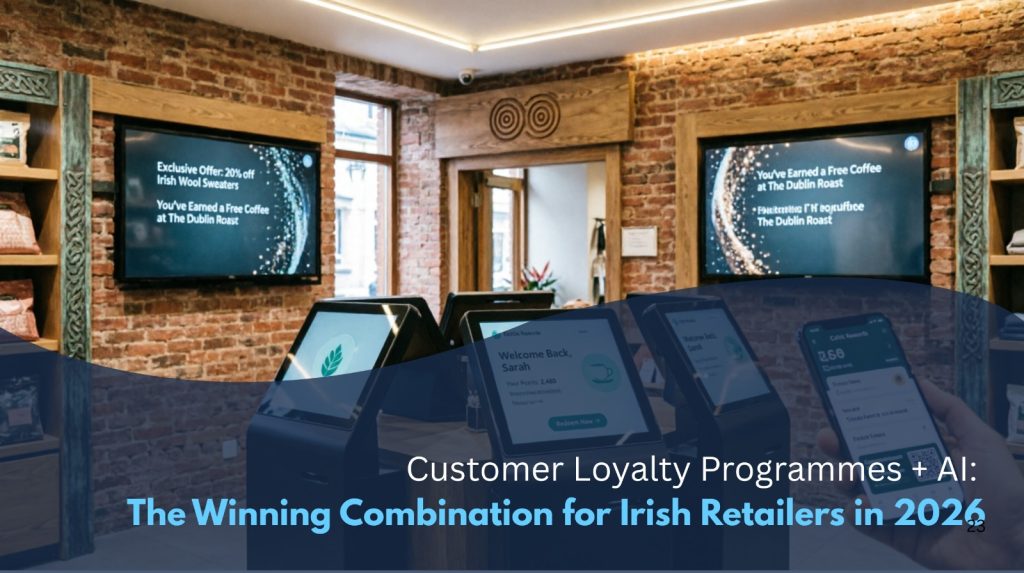
One of the most underutilised loyalty touchpoints in physical retail is the in-store interaction itself. Most loyalty programmes communicate through email and app notifications, but when the loyal customer is standing in your store, the experience is usually generic. No recognition, no personalised offer, no acknowledgement of the relationship. Ask-Ai changes this. When a loyalty member interacts with the AI kiosk, the system recognises them, acknowledges their membership status, and delivers a personalised, real-time offer relevant to what they typically purchase. The in-store AI interaction becomes the most immediate and impactful loyalty touchpoint in your entire programme.
Rewarding Engagement Beyond Transactions
The most effective loyalty programmes in 2026 reward behaviours beyond purchases: reviews, referrals, engagement with AI assistants, community participation, and feedback. Ask-Ai can be configured to recognise and reward these broader engagement behaviours, creating a positive feedback loop between AI usage and loyalty programme participation that deepens customer commitment over time.
The Financial Case for AI-Enhanced Loyalty
- Loyalty programme members who actively redeem rewards spend 3.1 times more annually than non-redeeming members. DontPayFull Loyalty Statistics, 2026.
- A 28 per cent reduction in loyalty programme churn is achievable when AI triggers proactive retention offers at the optimal moment. Mindit.io Retail AI ROI Benchmarks, 2026.
- AI-powered loyalty retention programmes generate a 4.2 times return on investment on retention programme spend. Mindit.io, 2026.
- AI churn prediction achieves up to 95 per cent accuracy in identifying at-risk customers before they disengage. Netguru, 2026.
The Irish Retail Context: Loyalty Has Always Been Personal Here
Irish retail has always had a particular cultural strength: the personal relationship between local retailers and their communities. The pharmacist who knows your name. The butcher who remembers your usual order. The bookshop owner who keeps aside a new release because they know the customer will love it. This is the spirit that AI-enhanced loyalty must capture at scale: making every customer feel known, valued, and genuinely understood, not as a data point, but as an individual worth serving well.
Ask-Ai’s approach to loyalty is designed precisely to deliver this experience at scale, extending the intimacy of a personal relationship to every member of your loyalty programme through intelligent technology that operates consistently across every visit.
Conclusion
Customer loyalty is the foundation of sustainable retail revenue. The loyalty programmes that are winning in 2026 are the ones powered by AI, delivering personalised, predictive, individually relevant experiences that feel genuinely valuable rather than generically promotional. For Irish retailers who have invested in a loyalty programme that is underperforming relative to its potential, connecting it to ask-Ai is the clearest path to transforming that investment into its full commercial value.
Take the Next Step for Your Store. Visit askai.ie today to see how ask-Ai helps Irish physical retailers serve every customer brilliantly, sell more confidently, and grow sustainably in 2026.
FREQUENTLY ASKED QUESTIONS
Q: Can ask-Ai integrate with my existing loyalty programme software?
A: Ask-Ai is designed to integrate with existing loyalty platforms and CRM systems. The specific integration approach depends on your current loyalty software. The ask-Ai team will advise on the most effective integration method for your setup and will manage the technical connection process so that your team does not need to handle it internally.
Q: Does ask-Ai require customers to log in or identify themselves to receive personalised loyalty experiences?
A: Personalised loyalty experiences require the customer to be identified through your loyalty programme, typically via a card scan, a QR code on a loyalty app, or a simple account lookup at the kiosk. Customers who choose not to identify themselves still receive the standard, excellent AI assistance. The loyalty layer adds an additional level of personalisation for members who opt in.
Q: How does AI predict which customers are at risk of disengaging from the loyalty programme?
A: Ask-Ai uses patterns in customer behaviour including declining visit frequency, reduced average spend, changes in product engagement, and reduced response to previous loyalty communications to calculate a churn probability for each loyalty member. When a member’s score crosses a defined threshold, the system can trigger a proactive, personalised retention offer automatically.
Q: Can AI loyalty capabilities work for a small independent Irish retailer without a sophisticated loyalty system?
A: Yes. Even a relatively simple loyalty data set, specifically purchase history linked to customer profiles, provides enough information for ask-Ai to begin delivering more personalised experiences than a generic points system offers. The sophistication of personalisation grows as data accumulates, but meaningful improvements are achievable from early in the deployment.
Q: What is the practical difference between AI-enhanced loyalty and a traditional email marketing campaign to loyalty members?
A: Traditional email campaigns deliver scheduled messages based on broad segments. AI loyalty delivers personalised, contextually relevant interactions in real time at the moment the customer is in your store and most receptive. The timing, the channel, and the personalisation are fundamentally different, which is why AI-enhanced loyalty consistently outperforms campaign-based approaches in engagement and ROI.