
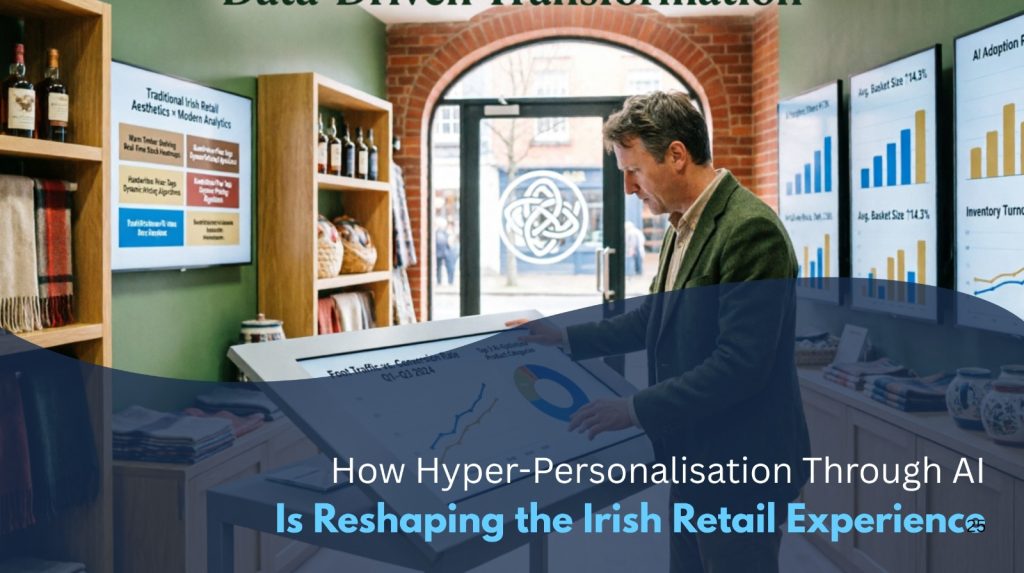
The Gold Standard of Irish Retail Has Always Been Personal
Great Irish retail has always been personal. The pharmacist who knows your medication history and checks it against a new prescription without being asked. The butcher who puts aside the specific cut you prefer because they remember your usual order. The bookshop owner who calls when a specific author releases a new title, because they have been listening carefully for three years. This is the kind of service that builds loyalty that lasts decades. It is also the kind of service that has historically been impossible to deliver at scale.
Serve 50 customers this way, and it feels like genuine personal service. Serve 500 customers simultaneously, across multiple departments, in multiple languages, during your busiest trading hour, and the personal element invariably becomes the casualty of operational pressure. In 2026, AI hyper-personalisation is solving this challenge. Ask-Ai makes the intimacy of a personal relationship available to every customer at every visit, not just the regulars who have built a relationship with your team over years.
📊 Consumers spend 37 per cent more with brands that personalise their experiences. 71 per cent of consumers expect personalised interactions and most feel frustrated when personalisation misses the mark. Deloitte Digital Research 2024 and McKinsey.
What Hyper-Personalisation Actually Means
The term personalisation is used loosely in retail. Addressing a customer by their first name in an email is personalisation. Offering a ten per cent discount to all loyalty members is broad personalisation. These are improvements over generic mass communication, but they are far from what AI-powered hyper-personalisation delivers.
Hyper-personalisation means treating every individual customer as a distinct segment of one, using real-time signals about their current behaviour, their purchase history, their preferences, their location in the store, and their engagement with the AI to deliver an experience that feels as though it was designed specifically for them. The TRIFFT Loyalty Report for 2026 describes this as the shift from demographic approximation to behavioural precision: every loyalty member treated as a distinct market of one individual.
Six Dimensions of AI Hyper-Personalisation in Irish Stores
Personalised Product Recommendations in Real Time
When a loyalty-registered customer interacts with an ask-Ai kiosk or QR code, the AI draws on their purchase history to generate recommendations specifically relevant to them. A customer who regularly buys organic health products is shown the new arrivals in their preferred range. A customer who purchases children’s clothing is shown age-appropriate new season items. These are not algorithmic guesses. They are precise, data-driven recommendations that arrive at the right moment and feel like genuine attentiveness.
Contextual Awareness
Ask-Ai’s personalisation considers context beyond purchase history. Time of day, current promotions, stock levels, and the department of the store the customer is browsing all inform the recommendation the AI makes. A customer exploring sports nutrition products at eight in the morning on a Sunday has different needs and receptiveness from the same customer browsing on a Thursday evening. AI adapts to context. Consistent human delivery of this level of contextual sensitivity at scale is simply not achievable.
Predictive Intent
One of the most powerful dimensions of hyper-personalisation is the ability to anticipate what a customer needs before they articulate it. By analysing patterns in customer behaviour, specifically what customers who made a similar purchase typically look for next, how preferences evolve across seasons, and which product combinations most consistently lead to satisfaction, ask-Ai can proactively surface relevant products and information before the customer knows to ask.
💡 Fast Company’s 2026 retail technology analysis describes this as the shift from reactive personalisation to predictive intent engines: AI that anticipates what a customer needs next based on contextual data rather than waiting for them to express a need.
Linguistic and Cultural Personalisation
Personalisation in the Irish context must include linguistic and cultural adaptation. A customer who engages in Polish does not just want Polish-language responses. They want an experience that reflects an understanding of their communication style, their cultural context, and their retail expectations. Ask-Ai’s multilingual capability is designed for this depth of personalisation, not merely translation.
In-the-Moment Loyalty Recognition
When a loyalty member interacts with ask-Ai in-store, the AI recognises their membership status and tailors the interaction accordingly. A long-standing member who visits regularly receives a warmer, more familiar acknowledgement of their history with your store than a first-time visitor. This recognition builds emotional loyalty, the sense that your store genuinely values the relationship rather than merely the transaction.
Dynamic Offer Personalisation
Rather than presenting the same promotional offer to every customer, AI selects dynamically the offer most likely to be relevant and persuasive for each individual. A customer with a history of buying premium products is shown a new premium range launch. A customer whose purchase history indicates value-consciousness is shown a relevant offer in their preferred category. The promotional budget goes where it is most likely to generate a response.
Why This Resonates Particularly in Ireland
Ireland has a retail culture that values the personal relationship. The enduring success of local independent retailers across the country is built on precisely this: personal knowledge of customers, genuine care for their needs, and the kind of service that feels individual rather than institutional. AI hyper-personalisation is not replacing this culture. It is extending it, making the quality of interaction that the best Irish retail has always delivered to its most loyal customers available to every person who walks through the door.
📊 Only 34 per cent of consumers believe retailers currently excel at personalisation, despite 71 per cent of retailers believing they deliver it well. This gap is the commercial opportunity for Irish retailers using AI. Envive Research cited by Anchor Group Tech.
The Commercial Results
- AI personalisation and conversational tools drive conversion rate improvements of between four times and 23 per cent. Cubeo AI, 2026.
- Personalisation leaders grow approximately ten percentage points faster annually than non-personalising competitors. BCG Research.
- Personalised shopping experiences using generative AI increase conversion rates by up to 15 per cent. Gladly AI in Retail, 2026.
- 78 per cent of consumers report a higher likelihood of repeat purchases from businesses that personalise their experience. HelloRep, 2026.
Conclusion
Hyper-personalisation is not the future of Irish retail. It is the present competitive standard that the best retailers are already delivering. Ask-Ai makes this level of personalisation accessible to every Irish bricks-and-mortar retailer, at the scale, consistency, and sophistication that builds genuine, lasting customer relationships. The store that knows its customers, serves them individually, and makes them feel valued at every visit is the store they return to. Ask-Ai makes that store yours.
Take the Next Step for Your Store. Visit askai.ie today to see how ask-Ai helps Irish physical retailers serve every customer brilliantly, sell more confidently, and grow sustainably in 2026.
FREQUENTLY ASKED QUESTIONS
Q: What data does ask-Ai use to deliver hyper-personalised experiences?
A: Ask-Ai draws on your live product catalogue for accurate current recommendations, your loyalty programme data for customer purchase history and preferences, the customer’s current interaction context including what they are asking about in this session, and aggregate behavioural patterns showing which products resonate with customers who have similar purchase profiles.
Q: Does hyper-personalisation require customers to share personal data?
A: Ask-Ai operates on two levels. Customers who engage through your loyalty programme receive the full depth of personalised experience. Customers who interact without identifying themselves receive contextual, session-based personalisation based on what they are enquiring about in the current visit. The platform is designed with GDPR compliance as a foundational principle throughout.
Q: How does AI hyper-personalisation differ from what large Irish chains like Tesco or Dunnes already do?
A: Large chains primarily deliver personalisation through loyalty email campaigns and app notifications at scheduled intervals based on broad purchase segments. Ask-Ai delivers personalisation in real time, in-store, at the moment of the shopping visit, based on the specific individual behaviour of the customer in the current session. The timing, the channel, and the specificity are fundamentally different.
Q: Can hyper-personalisation work for a small Irish retailer with limited customer history data?
A: Yes, though the depth of personalisation grows as data accumulates. From day one, ask-Ai delivers contextual personalisation based on the current session. As loyalty programme data builds over weeks and months, the historical dimension of personalisation deepens. Small retailers consistently see meaningful personalisation benefits from early in deployment.
Q: How does ask-Ai ensure personalisation feels helpful rather than intrusive to Irish customers?
A: Ask-Ai is designed to deliver personalisation that feels attentive and genuinely useful rather than surveillance-based. Recommendations are always framed as helpful information rather than demonstrations of data knowledge. Customers control their own data through loyalty programme settings, and the platform is transparent about how information is used.