
One of the most common complaints about AI retail technology is that it recommends products that are not available. A customer spends several minutes in a helpful conversation with a kiosk, identifies exactly what they want, and then discovers that the item is out of stock. Or worse, they buy something based on a price the AI quoted, and that price has since changed.
This is not a minor inconvenience. It is a trust-destroying experience that makes the retailer look disorganised and makes the AI look useless. It is also entirely preventable.
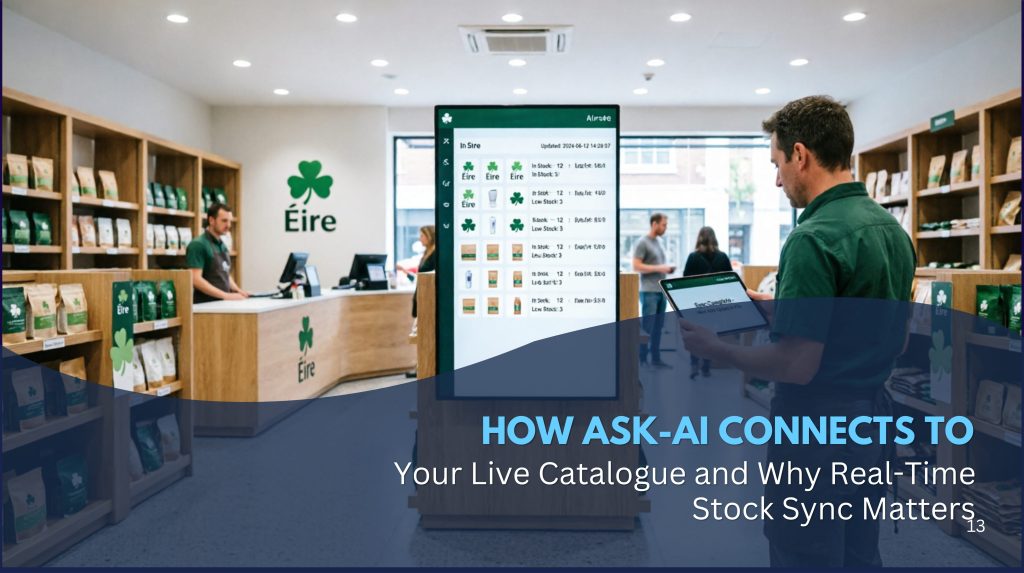
ask-Ai is built on a real-time product sync architecture that connects directly to the retailer’s live catalogue. Every recommendation the AI makes is based on what is actually in stock, at the actual current price, with accurate product information. This is not a nice-to-have feature. It is the foundation of everything else ask-Ai does.
What Real-Time Catalogue Integration Actually Means
When we talk about real-time catalogue integration, we mean that ask-Ai is not working from a static snapshot of your product range. It is not pulling from a database that was last updated this morning or last week. It is connected to your live inventory system, and every product interaction is informed by current data.
If you sell out of a product at 2pm on a Saturday, ask-Ai stops recommending it at 2pm on that Saturday. If you run a flash sale at 3pm, the discounted price is immediately available through the AI. If a new product arrives in stock, it is available for recommendation as soon as it is entered into the system.
This is what a truly helpful AI sales assistant requires to function properly. Outdated data produces wrong recommendations. Wrong recommendations produce frustrated customers. And frustrated customers do not buy.
How the Integration Works in Practice
ask-Ai connects to the retailer’s existing product management or ERP system as part of the onboarding process. The E-Retail Ireland team handles this integration end to end. The retailer does not need to maintain a separate product feed, manually update the AI’s knowledge, or manage any technical infrastructure on their side.
The platform runs on Google Cloud, which provides the performance, reliability, and speed that real-time data synchronisation requires. In a busy retail environment on a high-footfall Saturday, the ask-Ai system can handle a high volume of simultaneous customer interactions while pulling accurate product data for each one.
Why Outdated Product Information Is Worse Than No AI
A retailer who deploys an AI system with outdated product data is in a worse position than one who deploys no AI at all. The reason is expectation management. A customer who approaches a knowledgeable-looking kiosk expects accurate information. If that information turns out to be wrong, the disappointment is amplified by the expectation that was created.
Wrong stock information, outdated pricing, or recommendations for discontinued products all create a version of this problem. The customer loses trust not just in the AI but in the store itself. The technology that was supposed to enhance the experience has instead damaged it.
ask-Ai eliminates this risk by making real-time accuracy a non-negotiable foundation of the platform rather than an optional upgrade.
The Basket-Building Benefit of Live Data
Real-time stock sync is not just about avoiding mistakes. It also enhances the positive capabilities of the platform, particularly around basket building.
When a customer is guided toward related and complementary products, those suggestions need to be based on what is actually available right now. An AI that suggests a companion product which is out of stock has failed to build the basket. An AI that only suggests in-stock companions, potentially including a note that a first-choice item is temporarily unavailable with an alternative that is in stock, keeps the conversation productive and the sale alive.
Real-time data is what allows ask-Ai to make relevant, accurate, timely suggestions rather than generic ones based on what is usually in stock.
Price Accuracy and Promotional Integration
Irish retailers run promotions. Bank holiday sales, seasonal discounts, clearance events, and loyalty programme offers are all part of the normal rhythm of retail life. When these promotions are live in your system, ask-Ai reflects them immediately.
A customer who asks about a product that is currently on sale gets the sale price. A customer who asks about a product that qualifies for a loyalty discount sees that discount flagged in the product information. The AI is not working off a theoretical price list. It is working off the actual prices your customers would see at the till.
This consistency between the AI interaction and the checkout experience is a fundamental part of what makes ask-Ai trustworthy. Customers do not arrive at the till expecting one price and find another.
What This Means for Your Team
Real-time stock sync also has practical benefits for the in-store team. When staff receive a live agent handoff from the AI, the full context of the conversation, including the products that were discussed and the current stock and pricing information, is available to them immediately. They are not working from memory or making educated guesses. They have accurate information in hand.
This makes the handoff genuinely seamless for the customer. The staff member can pick up the conversation from exactly where the AI left off, with full confidence in the accuracy of the information they are working with.To see how ask-Ai’s live catalogue integration would work with your existing retail systems, book a free consultation at askai.ie, email info@e-retail.ie, or call 01 455 9511. The ask-Ai team is at Neolith House, Davitt Road, Dublin 12, Ireland.