
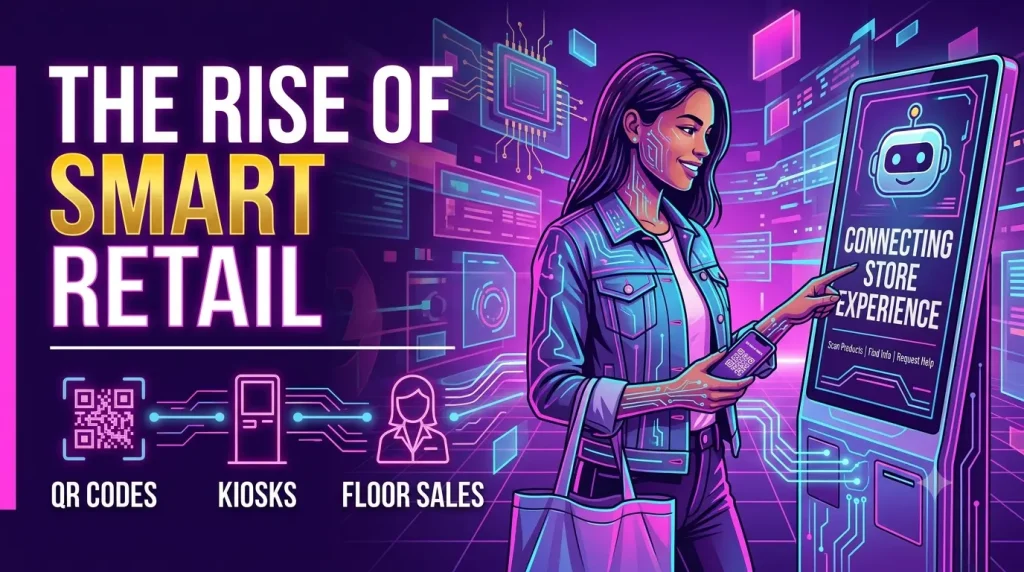
For years, the retail industry treated e-commerce and physical stores as two separate worlds, each with its own systems, its own data, and its own customer experience. That separation is disappearing fast. Smart retail technology is the term now used to describe stores that behave less like isolated brick-and-mortar locations and more like extensions of a single, connected digital experience, one that happens to have a physical address.
Smart retail is not a single gadget or app. It is the combination of connected devices, real-time data, and intelligent software working together so that a customer standing in your store has access to the same depth of information, personalization, and convenience they would get shopping from their couch. QR codes on shelf tags, interactive kiosks near entrances, digital displays showing live promotions, and AI assistants guiding product discovery are all pieces of the same puzzle.
Why is this gap closing now? Customer expectations have simply outpaced what traditional retail staffing and signage can deliver. Shoppers already research products, read reviews, and compare prices on their phones before they set foot in a store. If that same phone can now talk directly to your store’s inventory and recommend the right product on the spot, the line between “online” and “in-store” stops being meaningful. What matters is whether the experience is fast, accurate, and personalized, regardless of which screen it happens on.
For innovation managers and multi-location retailers, this shift represents both a challenge and an opportunity. The challenge is that customers will not wait around for a store to catch up. The opportunity is that the technology to close this gap is now mature, affordable, and easier to deploy than most people assume.
QR Codes and Interactive Kiosks: The New Sales Floor Infrastructure
The modern sales floor increasingly runs on two simple but powerful tools: QR codes and interactive kiosks.
QR code store engagement works because it meets customers exactly where their attention already is, on their own phone. A shopper scans a code next to a product and instantly gets detailed specifications, size and color availability, customer reviews, or a recommendation for a complementary item, all without needing to locate a staff member. This is particularly powerful during busy periods, when floor staff is stretched thin, and customers are unwilling to wait for basic information.
Interactive kiosks extend this same intelligence to shoppers who prefer a shared, in-store touchpoint rather than pulling out their own device. Positioned near entrances, changing rooms, or high-traffic product categories, a well-placed kiosk becomes a silent, tireless sales associate. It can answer product questions, check stock across locations, and even suggest items a customer had not considered, all in the time it would take a human associate to locate a single item in the stockroom.
Together, QR codes and kiosks do more than digitize the sales floor. They create a self-service layer that never gets tired, never has an off day, and never runs out of product knowledge, freeing your human staff to focus on the interactions that genuinely benefit from a personal touch.
Omnichannel Access: Putting Customers in Control
The real power of smart retail is not any single device. It is the fact that customers get to choose how they want to interact, and the experience stays consistent no matter what they pick.
This is the essence of a true omnichannel customer experience. A shopper might start browsing on their phone at home, walk into the store to see a product in person, ask a kiosk a follow-up question, and finish the purchase with help from a staff member, all as one continuous journey rather than three disconnected experiences. Nothing gets lost in translation between channels because the underlying product data, pricing, and recommendations stay identical everywhere.
Giving customers this control matters because shopping preferences are not uniform. Some customers want to interact entirely through their own phone and never speak to anyone. Others want the reassurance of a physical display and the option to ask a quick question. A smart retail strategy does not force a single path. It simply makes sure that whichever path a customer picks, from mobile to kiosk to digital signage, they get the same fast, accurate, and personalized experience.
Building a Unified Brand Experience Across Every Touchpoint
Consistency is what turns individual smart retail tools into a coherent strategy rather than a collection of disconnected gadgets.
Digital signage for retail should not just display static promotions. When connected to the same underlying product and inventory data as your kiosks and mobile experience, signage can reflect real-time stock levels, highlight trending products, and reinforce the same recommendations a customer might receive elsewhere in the store. This kind of consistency builds trust. Customers notice when the product reviews on a kiosk match what they saw online, and when a loyalty discount applies identically whether they are checking out on their phone or at the till.
This is where physical store automation earns its keep. Automating the flow of product information, reviews, stock levels, and loyalty program data across every touchpoint means your team is no longer manually updating signage or briefing staff on new promotions. The system stays synchronized on its own, and every customer touchpoint tells the same accurate story about your brand and your products.
How Ask Ai Powers Smart Retail With One Platform
Bringing all of these pieces together- QR codes, kiosks, digital signage, and mobile access- usually means juggling multiple vendors and disconnected systems. ask-Ai was built to remove that complexity entirely.
Ask Ai is an AI-first sales agent platform designed specifically for brick-and-mortar retail, giving you a single system that powers every customer touchpoint at once. Customers can engage through a kiosk, a QR code, a digital display, or their own mobile phone, and every interaction draws from the same real-time product catalog, so information is always accurate and always current.
The platform goes beyond static information delivery. It understands natural language questions, recommends complementary products to boost basket size, and detects when a customer would be better served by a live staff member, handing the conversation off seamlessly. Loyalty program integration means every customer gets a personalized experience regardless of which channel they use, and built-in analytics give innovation managers visibility into exactly how customers are engaging with the store, information that was previously invisible on the physical sales floor.
Bringing Omnichannel Intelligence Into Your Stores
The gap between online convenience and in-store experience is closing quickly, and the retailers who move first will define what “smart retail” looks like for their category. Whether you are managing a single flagship location or coordinating technology across dozens of stores, the building blocks- QR codes, kiosks, digital signage, and AI-driven guidance- are only as powerful as the platform connecting them.
If you are ready to bring true omnichannel intelligence into your physical stores, contact Ask Ai to see how a single AI-first platform can unify your sales floor. Explore more on how the technology works at askai.ie/ask-ai, or visit the Ask Ai homepage to start planning your smart retail strategy today.