
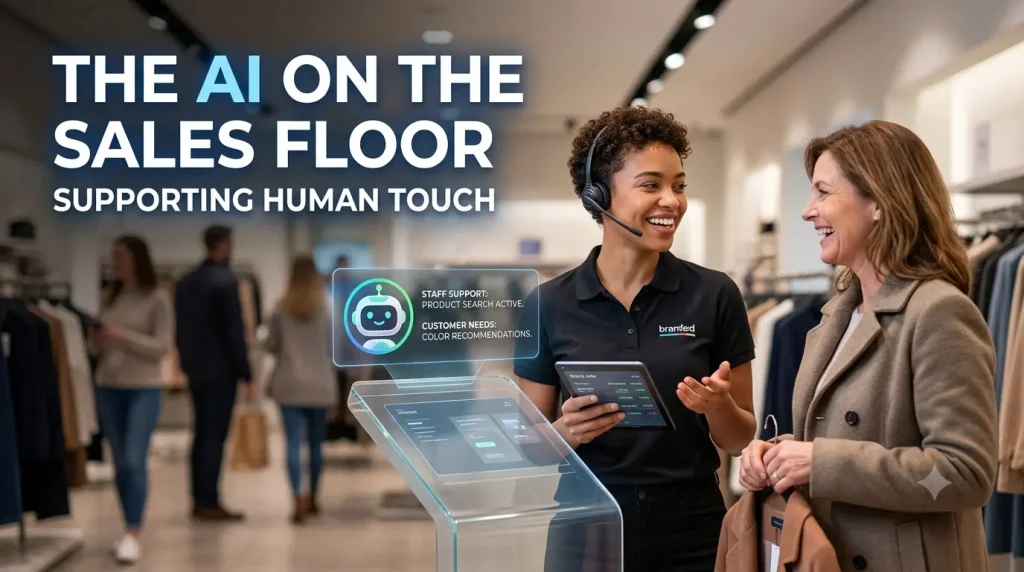
There is a persistent myth in retail circles that every new piece of AI technology is another step toward replacing the people on the shop floor. It is an understandable fear. Headlines about automation rarely make room for nuance, and HR leaders and store managers are often the ones left to manage staff anxiety when a new system gets rolled out.
But the reality of retail staff AI support looks very different from the narrative. The stores seeing the best results from AI are not the ones removing people. They are the ones giving their existing teams an assistant that clears away repetitive, low-value work so staff can spend their time where it actually matters: building relationships, closing sales, and solving problems that genuinely need a human being.
This is the real opportunity in modernizing store operations. AI is not there to replace judgment, empathy, or salesmanship. It is there to make sure your team’s time and energy go toward the interactions that need them most.
1. Handling the Repetitive Questions So Staff Can Focus on What Matters
Walk the floor of almost any store and you will hear the same questions repeated dozens of times a day. What time do you close? Do you have this in a medium? Is this on sale this week? None of these questions require a skilled sales associate. They require an answer, quickly and accurately.
When a conversational AI assistant handles store hours, simple inventory checks, and price checks, it frees staff from a constant stream of low-value interruptions. Instead of pausing a conversation with a customer who is ready to buy in order to answer a question about closing time, staff can stay focused on the shopper in front of them.
This is where sales associate assistive technology earns its keep. It is not about scripting the customer experience. It is about absorbing the routine so people can concentrate on the moments where a knowledgeable, present employee actually changes the outcome of a sale.
Practical takeaway: Track how many staff-hours per week are spent on questions that do not require expertise. Most stores are surprised by how much time this represents once it is measured.
2. Multilingual Communication That Removes a Real Barrier
International shoppers and tourists are a meaningful part of foot traffic for many retailers, particularly in city centers and shopping districts. But language gaps create friction on both sides of the counter. A non-native English-speaking customer may hesitate to ask questions. A staff member who is not confident in a second language may feel just as uncertain trying to help.
Multilingual customer service retail tools solve this quietly and effectively. When an AI assistant can communicate with a shopper in their own language, whether that is answering a product question or explaining a return policy, it removes a barrier that would otherwise fall entirely on the staff member to navigate alone.
This does not sideline your team. It supports them. A sales associate who knows the AI assistant can step in for the initial language gap will feel more confident engaging with international customers rather than avoiding those interactions out of uncertainty.
Practical takeaway: Identify your top three non-English languages spoken by customers in-store and confirm your AI assistant is fluent in each before rollout.
3. Live Agent Handoff: Knowing When a Human Needs to Step In
The single most important design principle behind good retail AI is knowing its own limits. Not every question has a simple answer, and not every customer wants to talk to a screen. This is where live agent handoff becomes essential.
A well-built assistant like Ask Ai is designed to detect when a query is becoming complex, emotionally sensitive, or simply better suited to a person. This might be a complaint, a nuanced product recommendation, or a shopper who is clearly frustrated and needs empathy rather than automation. In these moments, the system smoothly transfers the conversation to a human staff member, with relevant context already gathered, rather than leaving the customer to repeat themselves from scratch.
This is the piece that separates thoughtful retail staff AI support from a system that tries to do everything itself. The goal is not to minimize human involvement. It is to route each interaction to whoever, or whatever, is best equipped to handle it.
Practical takeaway: Review your handoff triggers regularly. The definition of a “complex query” should evolve as you learn what your customers actually need help with.
4. Boosting Employee Morale by Reducing Floor Congestion and Frustration
There is a quieter benefit to all of this that often gets overlooked in the AI conversation: staff morale. Retail work is demanding, and much of the daily stress comes not from difficult sales but from volume. Long queues of simple questions, frustrated customers who have been waiting for help, and the constant pressure of being pulled in five directions at once all take a toll.
When AI absorbs the repetitive and routine interactions, floor congestion eases. Customers get faster answers, which means less frustration reaches staff in the first place. Employees spend more of their shift doing the parts of the job that feel rewarding, like helping someone find the right product or closing a meaningful sale, and less time firefighting.
Reducing this kind of daily friction has a real effect on retention and job satisfaction, which matters just as much to operational teams as any sales metric.
Conclusion: Empowering Your Team to Perform at Their Best
AI on the sales floor is not about replacing the people who make a store worth visiting. It is about clearing the path so they can do their best work. From handling repetitive questions and bridging language gaps to knowing exactly when to bring a human into the conversation, the right assistant strengthens a retail team rather than shrinking it.
Ask Ai is built around this principle, combining assistive technology with a seamless live agent handoff so your staff is supported, not sidelined. If you are ready to see how this looks in your own stores, get in touch with Ask Ai and explore how modernizing store operations can start with empowering the people already on your team.