
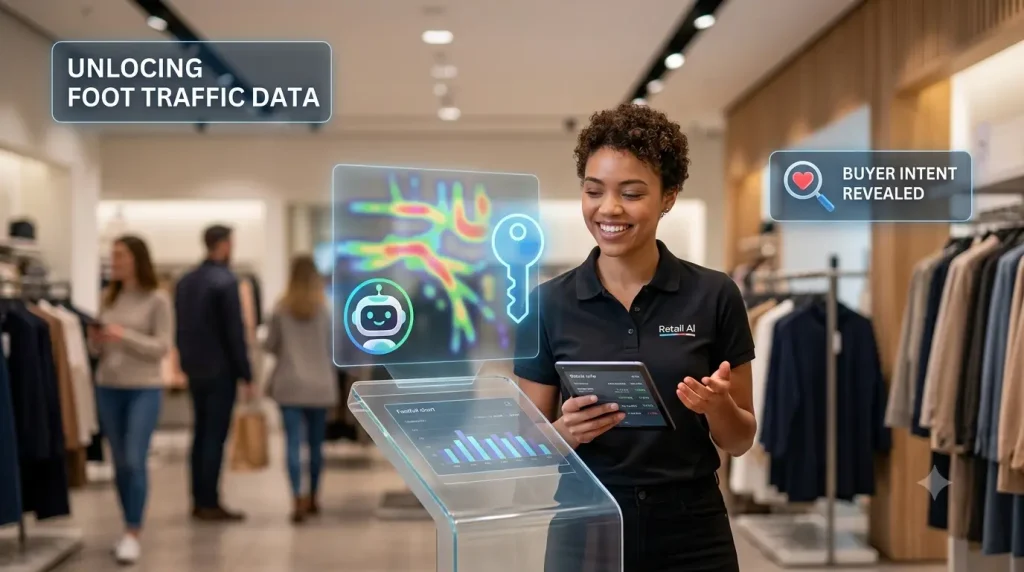
Every retail director knows their foot traffic numbers. Sensors at the door count how many people walked in, and point-of-sale systems record how many of them bought something. What almost no physical store can answer is the question that sits between those two numbers: what were the people who did not buy actually looking for, and why did they walk out empty-handed?
This is the blind spot that has quietly limited physical retail for decades. Online retailers have never had this problem. Every search query, every abandoned cart, every product page view is logged, analyzed, and fed back into merchandising and marketing decisions. A physical store, by comparison, has traditionally operated on instinct. Managers know their best-selling products and their busiest hours, but they rarely know how many customers walked out after failing to find a specific item, how many asked a question that no staff member could answer, or how many almost bought a second item but did not.
In-store retail analytics powered by AI is finally closing this gap. When customers interact with an AI sales assistant on a kiosk, through a QR code, or on their own phone, every question, every search, and every unfulfilled request becomes a data point. For the first time, physical retailers can see not just what customers bought, but what they wanted, what confused them, and what almost convinced them to buy. That shift, from counting transactions to understanding intent, is the single biggest analytical upgrade available to bricks and mortar retail today.
Key Insight 1: Capturing Real-Time Search Queries and Unfulfilled Requests
The most immediate value of an AI sales assistant is that it turns every customer interaction into a searchable, analyzable record. Instead of a customer quietly asking a staff member whether a product comes in a different size and walking away when the answer is no, that question is logged, categorized, and available for review.
This is where customer query tracking becomes a genuinely new capability for physical retail. A retail analytics lead can now see, in aggregate, exactly what customers are asking for across every store location. Are shoppers repeatedly asking about a product that is out of stock? Is there a size, color, or configuration that customers want but the store does not carry? Are certain questions coming up so often that they point to a gap in signage, product information, or staff training?
Perhaps more importantly, unfulfilled requests, questions the AI assistant could not satisfy because the product or information simply did not exist in the catalog, become one of the most valuable data sets a retailer can collect. These are not hypothetical customers. They are shoppers who were standing in the store, ready to buy, and left because the answer was not available. Tracking these moments turns invisible lost sales into a concrete, prioritized list of fixes.
Key Insight 2: Trending Products, Objections, and High-Converting Combinations
Beyond individual queries, patterns start to emerge once enough interactions accumulate. This is where shopper behavior data moves from anecdotal to statistically meaningful.
Trending products often reveal themselves in-store before they show up in sales figures. A spike in questions about a particular item, even before it starts selling in volume, can signal early demand that a store can get ahead of with better placement or increased stock. Conversely, a product with strong online buzz but very few in-store queries might indicate a display or awareness problem rather than a genuine lack of interest.
Common objections are equally revealing. If an AI assistant consistently fields concerns about price, sizing, or material across a specific product category, that is a clear signal for merchandising and marketing teams. These objections, previously heard only in passing by individual sales staff and rarely reported upward, become a structured feed of customer sentiment that can directly inform how products are positioned and priced.
High-converting item combinations are another layer entirely. When an AI assistant recommends a complementary product and the customer follows through with both purchases, that pairing becomes a data-backed insight rather than a guess. Over time, this reveals which cross-sell and upsell combinations genuinely work in a physical setting, information that can then inform bundling, promotions, and even physical store layout.
Key Insight 3: Turning Buyer Intent Into Action
Data on its own does not move a business forward. The real value comes from acting on it, and this is where physical store conversion metrics built on buyer intent start to reshape decisions across the business.
Store layout is one of the clearest beneficiaries. If customer queries consistently show shoppers struggling to find a certain product category, that is a strong signal the layout is working against the customer rather than for them. Rather than relying on periodic customer surveys or anecdotal staff feedback, retailers can use actual query volume and location data to guide where high-demand products should sit.
Inventory ordering improves in a similar way. Unfulfilled requests for specific sizes, colors, or products give buying teams a direct line to unmet demand, rather than relying purely on historical sales data that, by definition, cannot capture what customers wanted but could not get. This reduces both overstock on slow-moving items and stockouts on products customers are actively asking for.
Marketing campaigns also become sharper. Instead of guessing which products to feature in a seasonal promotion, marketing directors can look at real query volume and objection data to identify what is already capturing customer attention in-store, then build campaigns that reinforce and accelerate that existing interest.
Feature Focus: Turning Interactions Into Actionable Analytics
This entire process depends on having a system that not only handles customer interactions but also turns them into structured, usable data. This is exactly the role of the reporting dashboard built into ask-Ai.
Every conversation an AI sales assistant has with a customer, whether through a kiosk, a QR code, or a mobile interaction, is captured and organized into retail data-driven insights that analytics leads and store owners can actually use. The dashboard surfaces trending queries, highlights unfulfilled requests, tracks which product recommendations lead to completed purchases, and shows how these patterns shift across different store locations and time periods.
For enterprise retailers managing multiple stores, this becomes particularly powerful. Rather than relying on individual store managers to report anecdotal observations, a centralized dashboard allows regional and national teams to compare buyer intent across locations, identify which stores are seeing demand for products that are not yet stocked, and roll out layout or inventory changes based on evidence rather than instinct.
Stop Guessing, Start Tracking Intent
Foot traffic counters and point-of-sale totals will always be part of retail measurement, but they were never designed to answer the question that matters most: what did the customers who walked out actually want? For too long, that answer has lived only in the memory of sales staff, if it was noticed at all.
An AI sales assistant changes that permanently, turning every customer interaction into a data point that reveals genuine buyer intent. For retail analytics leads, marketing directors, and enterprise store owners who are ready to move beyond guesswork, the opportunity is straightforward: capture the questions, track the objections, and let the data guide layout, inventory, and marketing decisions.
If you are ready to see what your customers are really searching for in-store, contact Ask Ai to explore the reporting dashboard in action, or visit askai.ie to learn more about how the platform brings buyer intent data into every physical store you manage.