
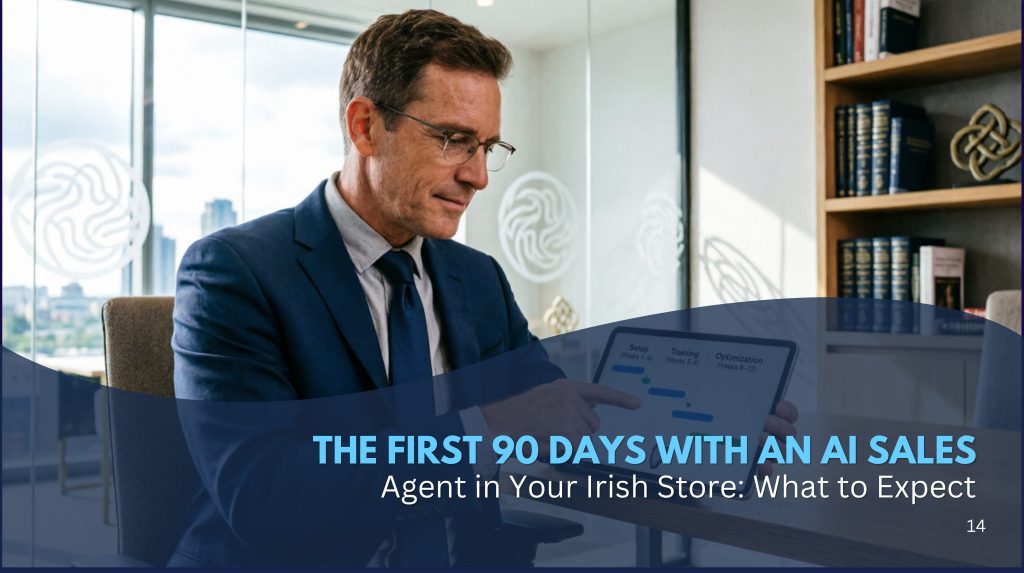
Deciding to add an AI sales agent to your Irish retail store is one thing. Understanding what actually happens after you make that decision is another. The technology industry is not always great at setting realistic expectations, and retailers have been burned before by products that promise transformation and deliver complications.
This article is a straightforward account of what the first 90 days with ask-Ai actually looks like. What happens in the setup phase. How the first weeks of live operation typically go. What you will start to see in the data. And what you can realistically expect in terms of commercial impact by the time three months have passed.
Before Day One: The Onboarding Process
Before ask-Ai goes live in your store, the E-Retail Ireland team works through an onboarding process that is managed entirely on their side. Your job as the retailer is to provide access to your product catalogue system and to confirm the configuration preferences that reflect your specific store.
The team connects the ask-Ai platform to your live inventory, configures the language settings appropriate to your customer base, and sets up the hardware or QR code infrastructure for your chosen deployment format. If you are using a kiosk, it arrives pre-configured. If you are deploying via QR codes, those are set up and tested before going live.
The E-Retail Ireland team also walks your staff through how the platform works, what live agent handoff looks like in practice, and how to access the insights dashboard. This is not a lengthy or complex training process. The system is designed to be intuitive for both customers and staff.
Days One to Fourteen: The Settling-In Period
The first two weeks of live operation are a settling-in period. This is normal and expected. Customers are encountering the kiosk or QR code for the first time. Some will engage immediately. Others will take a few visits before they feel comfortable interacting with it.
During this period, the most important thing you can do as a retailer is to ensure the kiosk is positioned well and that your staff are actively directing customers toward it for appropriate queries. Not every customer needs the AI. But the customers who are browsing without a clear product in mind, or who have questions that your staff do not have time to address immediately, are ideal candidates for an ask-Ai introduction.
You will also start to see the first data coming through the insights dashboard. Even in the first two weeks, patterns begin to emerge. Which products are generating the most questions? Which time of day is seeing the highest kiosk engagement? What are customers asking that the AI is handling well, and where might the responses need refinement?
Weeks Three to Six: The Platform Finds Its Rhythm
By weeks three to six, most customers who visit the store regularly will have encountered the AI. The novelty of the kiosk starts to normalise, and you begin to see it functioning as a genuine part of the store’s customer service infrastructure rather than an experiment.
Customer engagement rates typically increase during this period. Word of mouth within a loyal customer base means that people who have heard about the kiosk from a friend or family member come in specifically to try it. Staff become more fluent in directing customers toward it. The live agent handoff process becomes smoother as the team develops comfort with the notification and handover routine.
The data from this period is particularly valuable for refining the product catalogue configuration. If certain categories are consistently underperforming in terms of AI engagement, that may indicate a need to review how those products are described or categorised within the system.
Weeks Seven to Twelve: The Commercial Picture Emerges
By the end of the first ninety days, the commercial impact of ask-Ai begins to show up clearly in your transaction data. The key metrics to watch are average transaction value, the frequency with which basket-building suggestions are being accepted, and the conversion rate of customers who engage with the AI versus those who do not.
Retailers who have deployed ask-Ai consistently report that customers who engage with the platform show higher average basket values than those who do not. The basket-building functionality, which suggests related and complementary products in the context of an active conversation, is the primary driver of this uplift.
Return rates also tend to decrease over this period, because customers who have gone through a detailed AI-assisted buying process are making more informed decisions. The post-purchase mismatch that drives so many returns is reduced when customers have had access to accurate, detailed product information before they buy.
What to Do With the First 90 Days of Data
By the end of the first ninety days, you will have a rich dataset about how your customers are shopping. The ask-Ai insights dashboard tracks every conversation, and the patterns that emerge are consistently useful for business decisions beyond the immediate operation of the AI.
- Review the most frequently asked questions that the AI handled. Are there product information gaps you should address?
- Identify the products that generated high interest but low conversion. Is this a pricing issue, a stock issue, or a presentation issue?
- Look at the times of day and days of the week with the highest AI engagement. Does your staffing reflect those peaks?
- Review the live agent handoff data. Which types of queries are most commonly triggering a human handover? Could any of those be addressed by refining the AI configuration?
The first ninety days with ask-Ai are not just a technology deployment. They are a data collection and learning period that makes every subsequent decision smarter.To start your own 90-day journey with ask-Ai, book a free consultation at askai.ie, email info@e-retail.ie, or call 01 455 9511. The team is based at Neolith House, Davitt Road, Dublin 12, Ireland.