
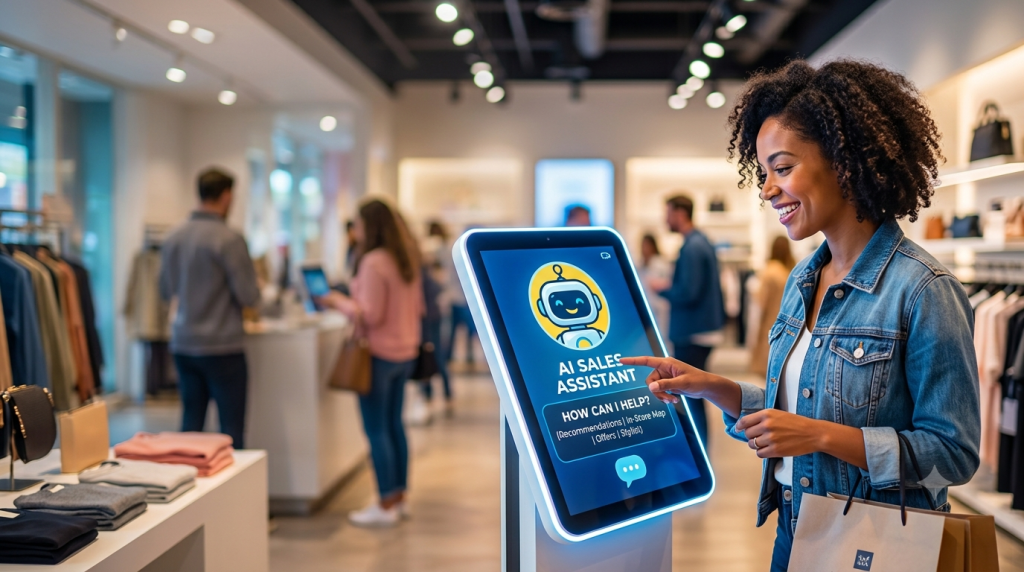
Walk into almost any store today, and you will notice something has changed about the way customers behave. They pull out their phones to compare prices before they have even reached the till. They expect product information instantly, not after tracking down a staff member. They want the same speed and personalization they get from online shopping, only now while standing in the aisle.
This shift in expectation is the biggest challenge facing brick-and-mortar retail today. Customers are no longer comparing your store to the shop down the road. They are comparing it to Amazon, to same-day delivery apps, and to every other frictionless digital experience they use daily. If your physical store cannot answer a question in seconds, that customer has every incentive to walk out and buy from someone who can.
This is where an AI sales assistant for retail changes the equation. By bringing intelligent, always-available support onto the shop floor, retailers can finally close the gap between the convenience of online shopping and the tangible experience of in-person shopping. In this post, we will look at the challenges driving this shift, how AI-powered platforms solve them, and why more retail directors are turning to solutions like ask-Ai to modernize their stores.
The Challenge: Staffing Gaps, Busy Floors, and Lost Sales
Most retail managers already know the pain points intimately.
Staffing shortages are a constant reality. Retail has one of the highest staff turnover rates of any industry, and finding, training, and retaining knowledgeable sales staff is a costly, ongoing battle. Even well-staffed stores struggle to keep every team member up to date on every product, price, and promotion across a growing catalog.
Busy sales floors mean customers wait. During peak hours, weekends, or seasonal rushes, staff is stretched thin. A shopper with a simple question, such as whether a product is in stock in their size, may wait several minutes for help that never quite gets prioritized.
Lost sales happen quietly. Unlike an abandoned online cart, a customer who leaves a physical store without buying rarely leaves a trace. They do not fill out a survey explaining that they could not find the right product or get their question answered. They simply walk out, and the retailer never sees the missed opportunity in the numbers, only in the revenue that never materializes.
Combined, these challenges create a service gap that is increasingly visible to customers who have grown used to instant answers everywhere else in their lives. Retailers who ignore this gap are not just risking a slower shopping experience; they are risking the sale itself.
The Solution: AI-Powered Guidance on the Shop Floor
An in-store AI platform closes this gap by putting a knowledgeable, tireless assistant directly in front of the customer, exactly when and where they need it.
In practice, this looks like an interactive retail kiosk positioned in a high-traffic area, a QR code placed near a product display, or a mobile-friendly chat experience customers can access on their own phone. Whichever entry point the customer chooses, the outcome is the same: they type or speak a question in natural language, such as “do you have this jacket in a medium” or “what’s the best wireless headphones under 100 euros,” and the AI sales assistant responds instantly with accurate, relevant answers pulled directly from the store’s live product catalog.
This is fundamentally different from a static kiosk or a simple search bar. A modern AI sales assistant understands intent, not just keywords. It can guide a customer through a discovery process the way a great sales associate would, asking clarifying questions, suggesting alternatives, and recommending complementary products, all without the customer ever needing to flag down staff.
Because the assistant is always available and never gets overwhelmed during busy periods, it effectively multiplies the capacity of your sales floor. Staff is freed up to focus on high-value interactions, closing sales, and handling complex requests, while the AI handles the repetitive, high-volume questions that would otherwise create bottlenecks.
Key Benefits of an AI Sales Assistant for Retail
High-Speed Product Discovery
Customers no longer need to wander the store hoping to stumble across what they need. An AI sales assistant surfaces the right product in seconds based on natural language input, cutting decision time dramatically and reducing the frustration that leads to abandoned visits.
Instant Stock Checks
One of the most common reasons customers leave a store empty-handed is uncertainty about stock. Is the item available in their size? Is there more in the back? An AI assistant connected to live inventory answers these questions in real time, removing the guesswork and the need to interrupt a staff member for a quick stock check.
Multilingual Support
Retail footfall is increasingly international, whether that is tourists, students, or a diverse local community. An AI assistant that communicates fluently in multiple languages and dialects ensures no customer feels underserved simply because of a language barrier, expanding your effective customer base without hiring additional multilingual staff.
Zero Wait Times
Perhaps the most important benefit of all: customers get answers immediately, regardless of how busy the floor is. There is no queue for the AI assistant. This alone can be the difference between a completed sale and a customer who leaves to buy elsewhere.
Together, these capabilities represent a genuine leap forward in bricks and mortar retail tech, giving physical stores a fighting chance against the convenience of online-only competitors.
Why Ask AI Is Built for This Moment
Not every AI tool is designed with the realities of physical retail in mind. ask-Ai was purpose-built as an AI-first sales agent platform specifically for brick-and-mortar businesses, and that focus shows in the details that matter most to retail teams.
The platform connects directly with your live inventory catalog, meaning every product recommendation, price, and stock answer reflects what is actually on the shelf right now, not outdated information from last week’s stocktake. This real-time product sync is what separates a genuinely useful customer engagement tool from a gimmick.
Ask Ai also recognizes when a customer’s question goes beyond what an automated assistant can or should handle, and seamlessly hands the conversation off to a live staff member. This live-agent handoff ensures customers always feel supported, whether their question is simple or requires a human touch, and it means your team stays in the loop on high-value conversations rather than being replaced by the technology.
Add to that omnichannel access through kiosks, QR codes, mobile, and digital displays, plus features like basket building, hyper-personalization through loyalty program integration, and data-driven insights into customer behavior, and it becomes clear why more retailers are treating an AI sales assistant as essential infrastructure rather than an experiment.
The Future of Retail Is Already Here
Customers are not going to lower their expectations, and the retailers who thrive over the next few years will be the ones who meet those expectations head-on rather than hoping foot traffic alone will carry the business. An AI sales assistant is no longer a futuristic add-on; it is a practical, measurable way to reduce lost sales, support your staff, and give every customer the fast, informed experience they now expect as standard.
If you manage a retail store, oversee multiple locations, or are simply looking for a way to modernize the in-store experience without overhauling your entire operation, now is the time to explore what an AI-first platform can do for your business.
Ready to see it in action? Book a demo with Ask Ai today and discover how an AI sales assistant can transform your sales floor into a smarter, faster, and more profitable customer experience. For more insights on retail technology trends, visit the Ask Ai blog or head back to the Ask Ai homepage to learn more about the platform.