
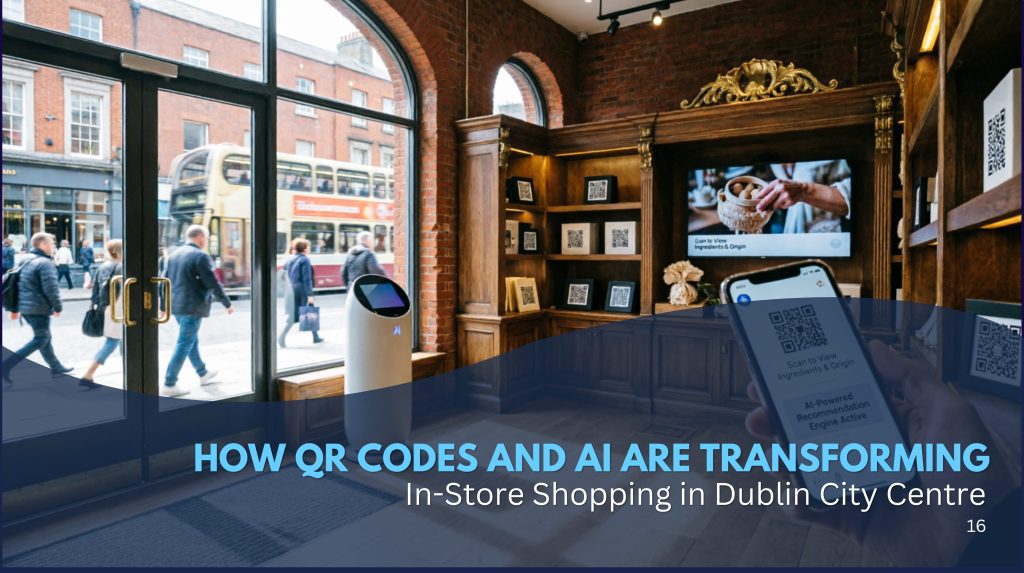
Dublin city centre is one of the most densely competitive retail environments in Ireland. Grafton Street, Henry Street, the surrounding side streets, and the expanding retail corridors in areas like the docklands and Rathmines are home to a mix of flagship international stores, long-established Irish retailers, and independent specialists, all competing for the attention and spending of a customer base that is increasingly informed, increasingly impatient, and increasingly comfortable using their phone for everything.
In this environment, the retailers who are gaining ground are not necessarily the ones with the biggest floor space or the biggest marketing budgets. They are the ones who are finding smarter ways to engage customers in the moments that matter. And one of the most practical and immediate ways to do that in 2026 is through the combination of QR codes and AI-powered retail assistance.
Why QR Codes Work So Well in a City Centre Retail Environment
The QR code has had an interesting journey in Irish retail. For a while, it was dismissed as a technology solution looking for a problem. Then the pandemic normalised scanning codes for menus, check-ins, and information, and suddenly an entire population became comfortable pulling out their phone and pointing it at a square code.
In a city centre retail context, the QR code solves a specific and consistent problem. Dublin shoppers, particularly on busy high streets like Grafton Street, are time-pressed, self-directed, and often reluctant to wait for a staff member. They want information quickly. They want to make decisions at their own pace. They want the option of engaging with a store on their own terms without having to flag down a sales assistant.
A QR code positioned on a product display, at the entrance to a store, or on shelf-edge labelling gives those customers exactly what they want. They scan, they engage, they get the information or recommendation they need, and they move forward in their purchase journey without friction.
What Happens When a Dublin Shopper Scans an ask-Ai QR Code
When a customer scans an ask-Ai QR code in a Dublin retail store, they access the full ask-Ai sales assistant experience directly on their own phone. No app download required. No account creation. They simply scan and begin a conversation.
The AI connects to the store’s live product catalogue in real time. The customer can ask about a specific product, request recommendations based on their needs, compare options, read customer reviews, check current pricing, and save a list of products they are considering. All of this happens on their phone, in their hands, at whatever pace suits them.
The experience is not designed to feel like a corporate automated system. It is designed to feel like a knowledgeable, helpful assistant who happens to know everything that is in stock and available right now. For a Dublin shopper on a busy Saturday afternoon, that is a meaningfully better experience than waiting for a staff member who may be serving someone else.
Deployment Across Dublin Retail Formats
One of the practical advantages of QR code-based deployment for Dublin city centre retailers is the flexibility it offers. A QR code requires minimal floor space, no electricity supply, and can be repositioned as needed. For compact Dublin boutiques or stores in historic buildings where physical kiosk installation might be challenging, QR codes are the ideal deployment format.
For larger stores with more floor space, the optimal approach is often a combination of a centrally positioned kiosk for customers who want a larger screen experience and QR codes distributed throughout the store for section-specific engagement. A sports retailer on Grafton Street might have QR codes in the running section, the football section, and the outdoor gear section, each configured to open the AI experience with that category as the starting context.
From Grafton Street to the Neighbourhood High Street
The QR code and AI combination that works on Grafton Street works equally well in neighbourhood retail across Dublin. The Ranelagh village shops. The independent retailers in Phibsborough. The specialist stores in Stoneybatter. The growing retail community in Glasnevin.
Dublin is a city of neighbourhoods, and each neighbourhood has its own retail character. ask-Ai can be configured to reflect the personality and range of any Dublin retail store, regardless of size or location. The same technology that serves a flagship retailer on a major high street serves an independent boutique in a village, because it adapts to the catalogue and context of each specific store.
The Data Advantage for Dublin Retailers
Every ask-Ai interaction via QR code generates data that goes back to the retailer’s insights dashboard. For Dublin retailers who are making decisions about which products to stock, which promotions to run, and how to configure their floor space, this data is genuinely valuable.
Understanding which products generate the highest QR engagement on a Thursday evening versus a Saturday afternoon, which comparisons customers are making most frequently, and which sections of the store are driving the most AI conversations gives a Dublin retailer a much sharper picture of their customer than footfall counters or sales reports alone can provide.
The ask-Ai Commitment to Dublin Retail
ask-Ai is a project by E-Retail, Ireland. It is not a product built elsewhere and adapted for the Irish market. It is built by people who understand how physical retail works in Dublin and across Ireland, and it is designed around the realities of the Irish shop floor rather than the assumptions of a global technology company.To explore how QR codes and ask-Ai could transform the in-store experience in your Dublin retail location, book a free consultation at askai.ie, email info@e-retail.ie, or call 01 455 9511. The team is based at Neolith House, Davitt Road, Dublin 12, Ireland.