
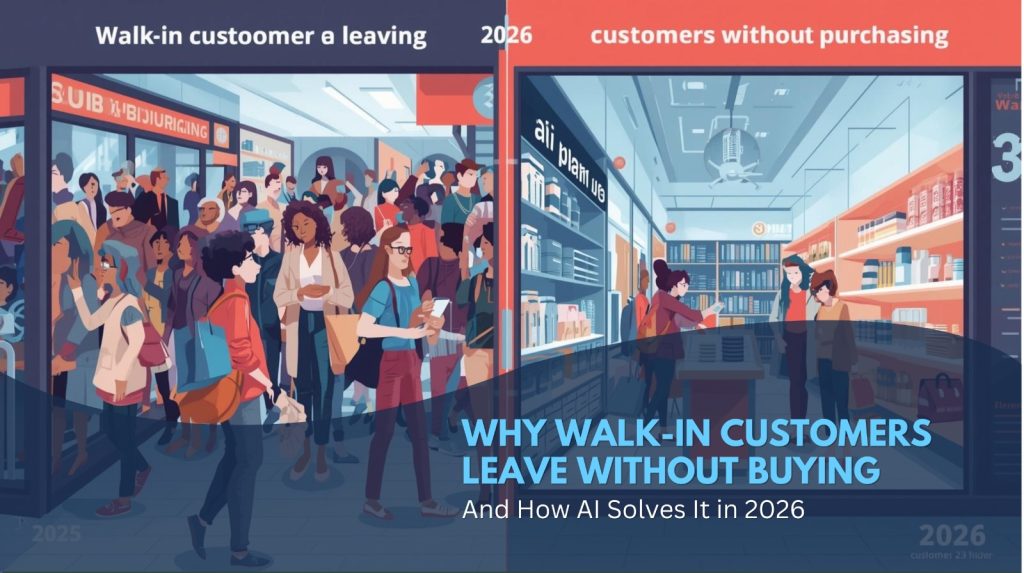
Getting customers through your door is a victory. But it is only half the battle. For many Irish physical retailers, there is a significant and costly gap between the number of people who walk in and the number who walk out with a purchase.
This gap the difference between footfall and conversion is one of the most important commercial metrics in physical retail. Every customer who walks in and leaves without buying represents a real cost: the overhead of running your store was spent on that visit, and no revenue was generated from it.
Understanding exactly why customers leave without purchasing and knowing how AI eliminates those reasons is one of the most valuable things an Irish retailer can know in 2026.
The Five Most Common Reasons WalkIn Customers Do Not Buy
Reason 1: They Could Not Find What They Were Looking For
Physical store navigation is significantly harder than online search. There is no search bar, no category filter, and no instant comparison. For a customer looking for a specific product in an unfamiliar store, the experience can feel slow and confusing. If they cannot find what they need within a reasonable time, most will leave often to find it online.
This is not a stock problem. It is an accessibility problem. The product may well be in your store but the customer cannot find it without help, and help was not available quickly enough.
Reason 2: They Had Questions That Went Unanswered
A customer considering a purchase often has important, specific questions before committing. Will this fit my model? Is there a shorter version? What do other customers say about this? Is there a guarantee? These are legitimate buying questions and when they go unanswered, the customer does not buy with uncertainty. They leave to find the answer elsewhere.
Research from Gladly’s 2026 Retail Report confirms that 68% of shoppers seek staff advice before making highervalue purchases. A store that cannot deliver that advice consistently because staff are busy or unavailable is systematically losing the customers most ready to spend.
Reason 3: The Wait Was Too Long
Modern consumers particularly those aged under 45 have extremely low tolerance for waiting. If a customer cannot get help within a minute or two of needing it, many will simply give up. This is not impatience for its own sake it is a rational response to a world where the same information is available instantly on their phone. If your store cannot match that speed, they will use their phone instead of your shop.
Reason 4: They Were Not Shown Relevant Products
Many customers arrive with one product in mind but would readily purchase additional items if they were relevant and presented at the right moment. This basketbuilding opportunity one of the most powerful revenue levers in physical retail is frequently missed because there is no proactive mechanism to surface complementary products instore.
The customer buys their one item and leaves, not knowing that the product they actually needed most was on the shelf behind them.
Reason 5: The Experience Did Not Match Their Expectations
Customers in 2026 are accustomed to excellent digital experiences instant information, seamless navigation, personalised recommendations. When a physical store feels slow, confusing, or generic by comparison, customers notice. The experience fails to meet their baseline expectation, and they are less confident making a purchase.
How askAi Directly Solves Each Conversion Killer
Solving Reason 1: Instant Product Discovery
Ask Ai acts as an alwaysavailable store guide. Via kiosk at the entrance, QR code on a shelf, or digital display in a department, customers can describe what they are looking for in plain language and be directed immediately to the right product. No searching. No confusion. No leaving without finding it.
Solving Reason 2: Every Question Answered, Instantly
Because askAi is connected to a retailer’s live product catalogue, it can answer any product question accurately and immediately specifications, stock availability, pricing, sizing, compatibility, warranty information, and customer ratings. Customers who receive accurate answers to their buying questions convert at dramatically higher rates than those who receive uncertainty or silence.
📊 AI chatbots and assistants increase retail conversion rates by up to 30% Fullview AI Customer Service Statistics 2025
Solving Reason 3: Zero Waiting Time
askAi is available to every customer simultaneously, with no queue and no wait time. At a kiosk, on a digital display, or via QR code on a personal phone the AI is always immediately available. This eliminates the frustration of waiting for staff and removes one of the most common reasons customers give up and leave.
Solving Reason 4: Proactive Basket Building
askAi does not wait for customers to ask about complementary products. At the right moment in a customer interaction when they are already engaged and considering a purchase the AI proactively suggests relevant additions that are currently in stock. This is intelligent, contextual recommendation, not a generic ‘you might also like’ prompt. Customers see products that are genuinely relevant to their specific query, at the moment they are most receptive.
Barilliance research shows that AIpowered product recommendations can drive up to 369% higher average order value in sessions where they are actively engaged. Even a fraction of this impact represents a meaningful uplift in revenue per transaction.
Solving Reason 5: An Experience That Matches Digital Expectations
When a customer walks into a store equipped with askAi and immediately receives instant, accurate, personalised assistance delivered in their preferred language, on the device or screen most convenient for them the experience matches and often exceeds what they expect from the best online retailers. The gap between digital expectation and physical reality is closed.
💡 A physical store that delivers the same quality of information and personalisation as a major online retailer combined with the sensory experience and immediacy that only an instore visit provides is a store that wins every time.
The Conversion Rate Opportunity for Irish Retailers
Improving instore conversion rate by even a small margin has an outsized impact on revenue. Consider an Irish retailer with 500 weekly visitors and a current conversion rate of 30%. That is 150 transactions per week. Moving that conversion rate to 35% a modest improvement achievable through better information delivery and engagement produces 175 transactions: 25 more per week, 1,300 more per year, from the same footfall and the same overheads.
This is the commercial power of fixing conversion. And askAi is the most practical tool available to Irish retailers for making it happen.
Conclusion
Walkin customers who leave without buying are not an accepted cost of doing business in physical retail. They are a conversion problem with a clear, proven solution. askAi addresses every major reason customers leave without purchasing instantly, accurately, and at scale turning more of your existing footfall into revenue without spending more on marketing or advertising.
For Irish retailers who want to get more from the customers they already have, AI conversion optimisation is the most direct route to measurable revenue growth in 2026.
🚀 Ready to Transform Your Store? Visit askai.ie to discover how askAi helps Irish bricksandmortar retailers increase sales, serve more customers, and compete confidently in 2026.
FREQUENTLY ASKED QUESTIONS
Q: What is a good instore conversion rate for Irish physical retailers in 2026?
A: Conversion rates vary by retail category. Fashion and gift retailers typically see rates between 2040%, while specialist and highervalue retailers may see lower footfall but higher conversion. The key benchmark is improvement from your current baseline askAi typically drives measurable conversion rate improvements of 515 percentage points depending on the level of current customer engagement and information availability in your store.
Q: How does askAi know which complementary products to recommend?
A: askAi is trained on your specific product catalogue and can be provided with information about products that are frequently purchased together, complementary items, accessories, or related products. The AI uses this information alongside the context of the customer’s current query to surface relevant recommendations at the most appropriate moment in the conversation.
Q: Can askAi be used to reengage customers who are about to leave without buying?
A: askAi is primarily a proactive engagement tool it engages customers from the moment they interact with a kiosk, QR code, or digital display. For customers who have not yet engaged with the AI, prominent and wellplaced access points (clear signage directing customers to QR codes or kiosks) encourage initial engagement before the customer makes a decision to leave.
Q: Does AI instore assistance affect the feel or atmosphere of a physical retail store?
A: When implemented thoughtfully, askAi enhances the feel of a store rather than diminishing it. Kiosks and digital displays that are welldesigned and onbrand add to the store environment. The AI interactions themselves are designed to match your brand voice and tone. Many retailers find that customers comment positively on the modern, accessible feel that AI assistance creates.
Q: How does askAi help Irish pharmacies, fashion stores, and electronics retailers specifically?
A: Each retail category benefits in specific ways. Pharmacies benefit from accurate product information and multilingual communication for diverse patient demographics. Fashion retailers benefit from realtime size and availability guidance and complementary outfit recommendations. Electronics retailers see significant improvements in conversion from AIpowered specification guidance and compatibility checking all areas where unanswered questions commonly lead to abandoned purchases.